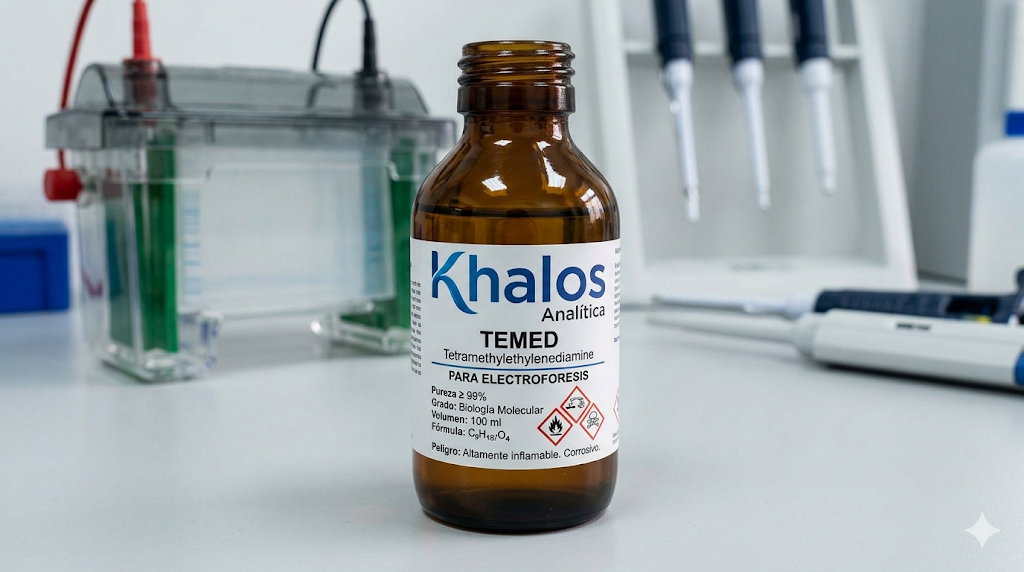
In the context of electrophoresis, TEMED (N,N,N',N'-Tetramethylethylenediamine) is a critical chemical reagent used as a catalyst for the polymerization of acrylamide and bis-acrylamide to create polyacrylamide gels. It is almost exclusively used in conjunction with Ammonium Persulfate (APS).
Core Function: How TEMED Works
Polyacrylamide gels are formed through a free-radical polymerization reaction. TEMED plays a specific, catalytic role in initiating this cascade.
1. Initiation by APS: Ammonium Persulfate (APS) is the initiator. In aqueous solution, APS spontaneously decomposes slowly to form free radicals (\text{SO}_4^{\bullet-}).
2. Catalysis by TEMED: TEMED acts as a tertiary amine catalyst. It exponentially accelerates the rate at which APS decomposes into free radicals.
3. Polymerization Cascade: The free radicals generated by the APS-TEMED reaction then attack the acrylamide monomers, converting them into free radicals. These activated monomers then react with other monomers (acrylamide) and crosslinkers (bis-acrylamide) to chain-react and form the solid, porous gel matrix.